AI Readiness Assessment Checklist for LLM Products Moving Beyond MVP
Most AI readiness assessment checklists are built for organizations still asking whether they should adopt AI. That is useful, but it is not enough for teams that already shipped an LLM feature, demo, internal copilot, RAG workflow, or agentic product path.
At that stage, the question changes. It is no longer just "are we ready for AI?" It becomes: is the infrastructure behind this AI product ready for production traffic, enterprise buyers, operational incidents, cost growth, and security review?
This checklist is for CTOs, heads of platform, engineering leaders, and AI startup founders who are moving from LLM MVP to production platform. Use it as a practical AI readiness assessment for the parts that tend to break after the demo works: RAG pipelines, agent tools, LLM routing, observability, Kubernetes operations, CI isolation, security controls, and ownership.
If you want an outside review of these risks, ToolLeap offers an AI Infrastructure Maturity Audit for LLM products moving beyond MVP.
What an AI readiness assessment should mean for LLM products
A generic AI readiness assessment usually checks strategy, data, governance, people, process, and executive alignment. Those categories matter, but they are broad. They answer whether an organization can start adopting AI.
An LLM product readiness assessment should answer a more concrete question: can the product run safely, repeatedly, and economically when AI becomes part of the customer experience?
That means looking past the model call itself. A production LLM product usually depends on a chain of systems:
- application services that call prompts, tools, retrievers, queues, workers, and model APIs;
- RAG pipelines that ingest, chunk, index, filter, retrieve, and refresh source material;
- agent runtimes that call tools, mutate state, and sometimes touch customer-owned data or systems;
- observability that can explain latency, cost, tool behavior, context quality, and bad answers;
- platform operations that make deployments, rollbacks, environments, secrets, and incidents repeatable;
- security and enterprise controls that satisfy buyers before the deal stalls.
The best AI readiness checklist for this stage is not a culture survey. It is an infrastructure maturity check.
When to run this checklist
Run this checklist when any of these are true:
- RAG is part of the product experience, not only an internal experiment.
- Agents can call tools, execute workflows, create records, or touch customer data.
- LLM usage is growing, but cost per customer, workflow, or request is unclear.
- Enterprise buyers ask about data residency, RBAC, audit logs, isolation, deletion, private deployment, or security review.
- Prompts, retrievers, model routing, and evals are spread across product code, notebooks, dashboards, and manual knowledge.
- Kubernetes, workers, queues, CI runners, and model-adjacent services exist, but no one owns the whole AI platform path.
- Support can see bad AI outcomes, but engineering cannot reproduce them quickly.
The earlier you run this assessment, the cheaper the fixes are. The most expensive moment to discover an AI infrastructure gap is during an enterprise security review, a customer incident, or a sudden spike in model spend.
How to score your AI infrastructure maturity
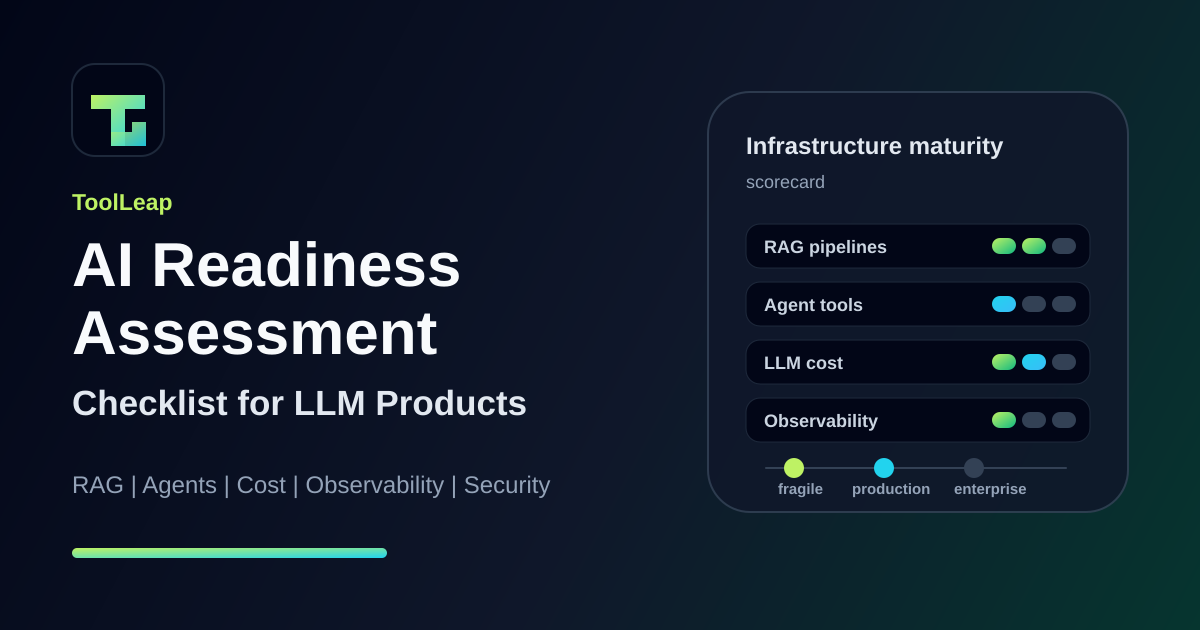
Use a simple 0 to 3 score for each section. Do not overcomplicate the math. The goal is to expose the pattern of risk.
| Score | Maturity level | What it means |
|---|---|---|
| 0 | Fragile | Works as a demo or manual process, but ownership, recovery, limits, or evidence are missing. |
| 1 | Experimental | Works for pilots, but there are known blind spots in cost, reliability, security, or observability. |
| 2 | Production-capable | Monitored, owned, bounded, documented enough to run with customers, and recoverable when failures happen. |
| 3 | Enterprise-ready | Auditable, isolated, scalable, cost-aware, and ready to support enterprise sales and operational review. |
Score each of the seven sections below. A low score in one area may be a backlog item. Low scores across RAG, agents, observability, and security usually mean you have a platform problem.
The 7-part AI readiness assessment checklist for LLM products
1. Product and platform architecture
The first readiness question is whether your team can explain the AI product path without guessing. Many LLM MVPs start with a direct model call inside product code. That is fine early on, but production systems need explicit boundaries.
Checklist questions:
- Can you draw the current request path from user action to model response?
- Can you identify where prompts, retrieval, model routing, tool calls, queues, workers, and persistence happen?
- Are AI workloads isolated from core product services where failure could cascade?
- Do you have clear owners for prompt infrastructure, RAG infrastructure, agent runtime, model routing, observability, and platform operations?
- Can a bad model response, failed retrieval, slow tool call, or rate limit degrade gracefully?
- Are there environment boundaries for local, staging, production, and customer-specific deployments?
You are production-capable when the AI path is visible, owned, and recoverable. You are enterprise-ready when the architecture can be explained to buyers, security reviewers, and internal operators without heroics.
2. RAG and data pipelines
RAG readiness is not just whether the vector database returns results. A production RAG system needs reliable ingestion, permission-aware retrieval, refresh paths, quality measurement, and traceability.
Checklist questions:
- Are ingestion jobs observable, retryable, and owned?
- Can you tell when a source document was last ingested, chunked, embedded, indexed, and refreshed?
- Are tenant permissions enforced at retrieval time, not only at document upload time?
- Can you trace which source documents or chunks influenced a generated answer?
- Do you have evals for retrieval quality, groundedness, stale context, and missing context?
- Is there a documented re-index path when embeddings, chunking, metadata, or permissions change?
- Can support investigate a bad answer without manually reconstructing the entire context path?
You are production-capable when RAG failures are detectable and explainable. You are enterprise-ready when retrieval respects customer boundaries, audit expectations, and data lifecycle requirements.
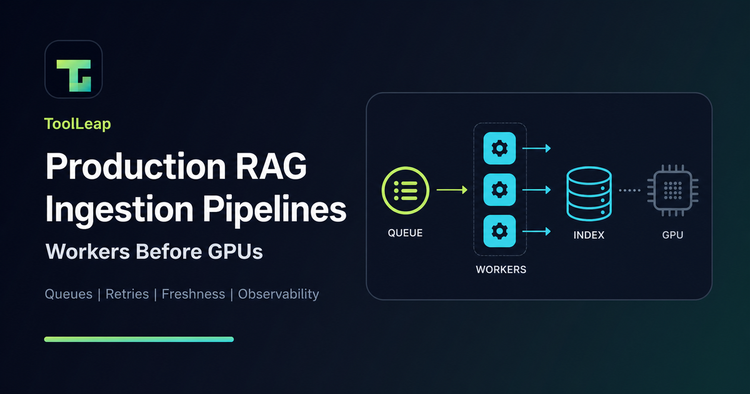
The engineering guide Production RAG Ingestion Pipelines: Why Workers Come Before GPUs explains the queue, retry, backpressure, and freshness controls behind that capability.
3. Agent tool runtime
Agentic systems create a different class of readiness risk because the model can choose actions. Even simple tool calling needs explicit controls once it reaches customer workflows.
Checklist questions:
- Are tools registered with owners, scopes, permissions, and rate limits?
- Are secrets isolated from prompts, model output, logs, and user-controlled content?
- Do risky actions require approval, confirmation, or policy checks?
- Can you replay or inspect tool calls after an incident?
- Are tool outputs sanitized before they become model context?
- Can agents fail closed when a tool is unavailable, slow, or ambiguous?
- Do you have test cases for prompt injection, tool misuse, escalation paths, and cross-tenant access attempts?
You are production-capable when tools have boundaries and logs. You are enterprise-ready when an auditor can understand what the agent was allowed to do, what it actually did, and why.
4. LLM inference, routing, and cost
LLM spend often looks harmless in prototype traffic and then becomes difficult to attribute later. Readiness means you can control model choice, latency, quality, fallbacks, and usage before growth forces the issue.
Checklist questions:
- Can you estimate cost per request, user, workspace, tenant, or workflow?
- Are model calls tagged by feature, customer, environment, and use case?
- Do you have routing rules for model selection, fallbacks, retries, and timeouts?
- Can you cap runaway usage at user, tenant, workflow, or system level?
- Do you know which prompts or workflows drive the most spend?
- Are latency and quality tradeoffs visible when changing models?
- Is private, hybrid, or self-hosted inference a real buyer requirement, or just premature complexity?
You are production-capable when cost and latency are measurable by product path. You are enterprise-ready when you can explain model dependency, fallback behavior, and usage controls to customers.
5. Observability, evals, and incident response
Traditional application monitoring is necessary, but it rarely explains AI-specific failures. LLM products need traces that connect product events, prompts, context, tools, models, costs, latency, and outcomes.
Checklist questions:
- Do traces include prompt version, retrieved context, model, latency, errors, tool calls, and cost?
- Can support reproduce a bad answer or failed workflow from a ticket?
- Are evals part of release changes for prompts, retrievers, tools, and model routing?
- Do you track answer quality, refusal patterns, hallucination risk, groundedness, and user-visible failure rates?
- Is there an incident path for AI-specific failures, not only application downtime?
- Who is on call for RAG degradation, model provider failures, tool misuse, or sudden cost spikes?
- Are runbooks written for the most common AI failure modes?
You are production-capable when failures can be detected, reproduced, and assigned. You are enterprise-ready when evals, traces, and runbooks become part of the release discipline.
6. Kubernetes, CI, and platform operations
Many AI products grow into platform problems quietly. At first, the AI feature is a few endpoints and scripts. Later, it becomes workers, queues, document pipelines, sandboxed runners, model gateways, evaluation jobs, and customer-specific environments.
Checklist questions:
- Are AI services, workers, queues, and background jobs deployed consistently across environments?
- Are infrastructure changes managed through IaC, GitOps, or another repeatable process?
- Can you roll back prompt, retriever, model-routing, and infrastructure changes?
- Are CI runners isolated if customer-owned code, data, or generated artifacts are involved?
- Are secrets, network boundaries, and workload identities explicit?
- Can the platform scale ingestion, evaluation, and inference-related jobs without starving the product?
- Do platform teams and product teams agree where AI infrastructure ownership begins and ends?
You are production-capable when deployments and operations are repeatable. You are enterprise-ready when platform boundaries can support scale, customer isolation, and operational evidence.
If this section exposes a broader platform issue, read ToolLeap's overview of AI platform engineering for the kind of infrastructure layer this usually becomes.
7. Security and enterprise controls
Enterprise AI readiness is often decided before the product demo. Buyers want to know how data moves, who can access it, where it is stored, how actions are logged, and whether AI dependencies introduce uncontrolled risk.
Checklist questions:
- Are RBAC, tenant isolation, secrets, service identities, and network boundaries explicit?
- Can you produce audit logs for AI interactions, tool calls, admin actions, and data access?
- Are data residency, retention, deletion, and customer-specific restrictions mapped to infrastructure behavior?
- Do prompts, retrieved context, generated output, and traces have retention rules?
- Are third-party model APIs, vector stores, observability tools, and agent tools reviewed as part of vendor risk?
- Can you support private deployment, customer cloud deployment, or hybrid architecture if enterprise sales require it?
- Do you have evidence ready for security questionnaires, not just verbal assurances?
You are production-capable when security controls exist and are enforced. You are enterprise-ready when those controls are documented, testable, and easy to explain during sales and security review.
How to interpret your score
Add the seven section scores for a maximum of 21 points.
| Total score | Readiness profile | What to do next |
|---|---|---|
| 0-7 | Not ready for production AI scale | Treat this as an infrastructure stabilization project before pushing more AI surface area into the product. |
| 8-13 | Pilot-ready, but enterprise risk is high | Prioritize the weakest sections before enterprise sales, large customer rollouts, or agentic workflows. |
| 14-18 | Production-capable with targeted gaps | Run a focused architecture review and close the highest-risk gaps in observability, security, and operations. |
| 19-21 | Enterprise-ready enough to scale with discipline | Keep improving evidence, automation, evals, and cost attribution as usage grows. |
The score is less important than the shape of the score. A team with strong Kubernetes operations but weak RAG traceability, weak agent controls, and weak AI observability is not ready just because the cluster is healthy. A team with good evals but no cost attribution may still be one enterprise pilot away from an unpleasant surprise.
If the score points to several weak areas at once, an AI infrastructure audit can help separate urgent production risks from improvements that can wait.
When an internal checklist is not enough
A self-assessment is useful when the gaps are obvious and narrow. It is usually enough if one dimension is weak and the owner is clear.
Bring in an external AI readiness audit provider when:
- three or more dimensions score below 2;
- enterprise sales depend on security, isolation, data residency, or audit evidence;
- RAG, agents, platform operations, and security are owned by different teams with no shared system map;
- LLM cost is growing but cannot be attributed to product behavior;
- incidents are difficult to reproduce because traces, prompts, retrieval, and tool calls are scattered;
- you are considering private LLM deployment, customer cloud deployment, or a major platform rebuild.
A good AI infrastructure audit should not produce a generic slide deck. It should produce a prioritized technical map: what is fragile, what blocks enterprise readiness, what can wait, and what should be fixed first.
What a focused AI infrastructure audit should produce
If you choose an external assessment, look for outputs that engineering can act on:
- a current-state architecture map of the AI product path;
- a maturity score across RAG, agents, inference, observability, platform operations, and security;
- a ranked list of production and enterprise-readiness risks;
- specific recommendations for ownership, isolation, deployment, tracing, evals, and cost controls;
- a 30/60/90-day remediation plan;
- clear decisions about what not to rebuild yet.
That last point matters. The best audit is not the one that finds the most work. It is the one that separates real production risk from interesting but unnecessary architecture churn.
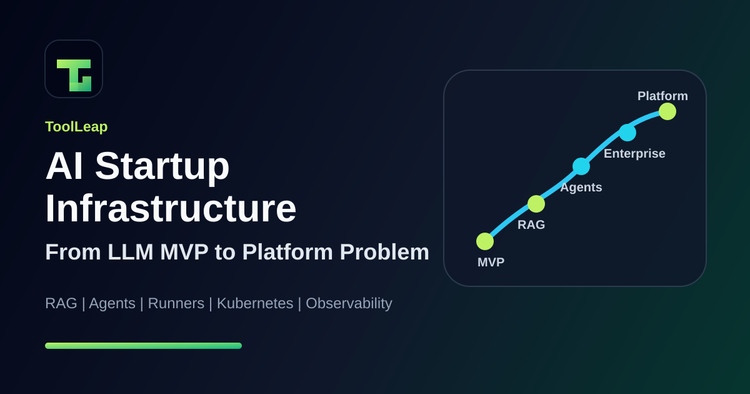
For a broader look at why this happens after the MVP stage, read AI Startup Infrastructure: From LLM MVP to Platform Problem.
FAQ
What is an AI readiness assessment checklist?
An AI readiness assessment checklist is a structured way to evaluate whether a team, product, or organization is ready to adopt, operate, or scale AI. For LLM products, the checklist should include infrastructure readiness: RAG pipelines, agent tools, model routing, observability, cost control, platform operations, and enterprise security controls.
How is this different from a general AI readiness assessment?
A general assessment usually focuses on strategy, data, governance, talent, and process. This checklist focuses on products that already use LLMs and need to become production-ready. It asks whether the AI infrastructure can be operated, secured, debugged, scaled, and explained to enterprise buyers.
Who should complete this checklist?
The best group is usually a mix of CTO, VP Engineering, Head of Platform, product engineering lead, security lead, and whoever owns AI-specific infrastructure. If RAG, agents, and model operations are spread across teams, complete the checklist together.
How long does an AI infrastructure audit take?
A focused audit can often be completed in days or a few weeks, depending on the size of the product, number of AI workflows, deployment complexity, and availability of architecture context. The goal is not to inspect every line of code. The goal is to find the infrastructure risks that can block production scale or enterprise adoption.
Do we need Kubernetes or self-hosted LLMs to use this checklist?
No. The checklist applies whether you use managed LLM APIs, hosted vector databases, Kubernetes, serverless jobs, or customer cloud deployments. Kubernetes and private LLM deployment become relevant when scale, isolation, compliance, latency, or buyer requirements make them necessary.
What score means we are ready for enterprise buyers?
A score above 19 is a strong signal, but the section pattern matters more than the total. Enterprise readiness usually requires strong scores in security, observability, platform operations, data controls, and audit evidence. A high total score with weak tenant isolation or missing audit logs is still a risk.
How do consultants assess AI readiness in businesses?
Most consultants assess business AI readiness across strategy, data, governance, operating model, talent, and technology. For LLM products, a technical audit should go deeper into the actual product infrastructure: RAG, agents, inference, evals, observability, cost attribution, CI/CD, deployment topology, and enterprise controls.
How should we choose an AI readiness assessment provider?
Choose a provider that matches the problem. If you need organization-wide AI adoption strategy, a broad advisory firm may fit. If you already have an LLM product and need production or enterprise readiness, choose a provider that can review architecture, infrastructure, observability, security, deployment, and platform operations in detail.
Next step
If your checklist shows several weak areas, treat that as a signal to pause and inspect the platform before adding more AI surface area. The next feature may not be the bottleneck. The bottleneck may be the infrastructure behind the feature.
ToolLeap runs an AI Infrastructure Maturity Audit for LLM products moving beyond MVP. We review the product architecture, RAG and agent infrastructure, LLM routing and cost, observability, Kubernetes and CI operations, and enterprise controls, then turn that into a prioritized remediation plan.