Production RAG Ingestion Pipelines: Why Workers Come Before GPUs
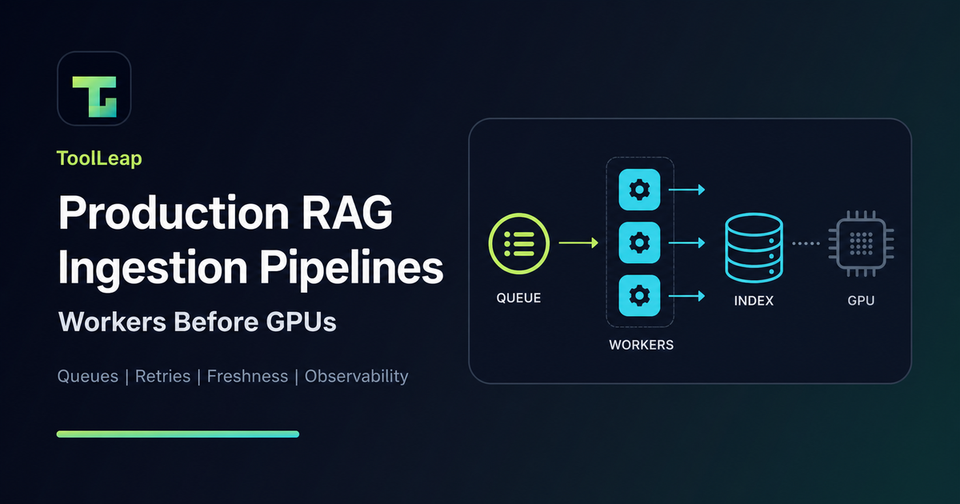
Short answer: a working RAG prototype usually needs a reliable ingestion control plane before it needs customer-managed GPU capacity. Queues, background workers, idempotent jobs, bounded retries, backpressure, freshness tracking, and retrieval evaluation solve a different class of problem than faster model compute.
A demo can accept a PDF, parse it, create embeddings, write vectors, and return a success response in one request. Production adds the cases the demo never exercised: a 300 MB upload, a parser crash after half the chunks were written, an embedding provider rate limit, a document that is replaced while the first version is still processing, a permission change, a delete that must reach the index, or a tenant that uploads the same source twice.
Adding a GPU may accelerate one stage of that path. It does not tell the product which source version is searchable, prevent duplicate vectors, replay a failed document safely, propagate a revoked permission, or explain why yesterday's policy is still appearing in answers.
This is the boundary between a RAG demo and production RAG infrastructure: ingestion becomes a durable, observable product workflow rather than a function called inside an upload endpoint.
A production RAG system has two different paths
Retrieval-augmented generation combines a retriever over external knowledge with a generator. That basic model goes back to the original RAG paper. In a real product, however, the architecture splits into two systems with different operating requirements.
The query path
The query path starts when a user asks a question. It resolves identity and access, creates a query representation, retrieves and reranks evidence, assembles context, calls a model, and returns an answer or fallback. Users feel its latency directly, so it needs a tight response-time budget and predictable degradation behavior.
The ingestion path
The ingestion path starts when source data is created, changed, deleted, or reconfigured. It fetches content, extracts text and structure, normalizes metadata, chunks the content, creates embeddings, writes or removes search records, validates the result, and marks a particular source version as searchable. Microsoft's integrated vectorization documentation describes the same broad sequence from source retrieval through extraction, chunking, vectorization, and indexing.
These steps can be slow, bursty, provider-limited, and partially successful. They should not inherit the timeout and lifecycle of the user-facing API process.
The query path serves answers. The ingestion path manufactures the searchable evidence those answers depend on.
Combining them in one process is convenient during validation. Keeping them combined after the product has real sources, tenants, and freshness expectations makes every ingestion failure look like a vague answer-quality problem.
Why synchronous RAG ingestion breaks in production
Moving work into the background is not primarily a speed optimization. It changes the execution contract.
1. The HTTP request is the wrong lifetime
Parsing, OCR, chunking, embedding, and indexing can take seconds or minutes. Clients disconnect, gateways time out, deployments restart processes, and users retry requests. If the only record of progress lives in the request handler, the system cannot distinguish “never started” from “finished half the work” or “completed, but the response was lost.”
A production intake API should first persist the source and its metadata, create a versioned job, then return a tracked status—often with 202 Accepted—while workers continue processing.
2. Partial success is normal
A document can be parsed successfully and fail during embedding. Nine batches can reach the vector store while the tenth is rejected. A worker can write vectors and crash before it records completion. Retrying the whole request without stable identity can create duplicates or mix two pipeline versions in the same active index.
Production ingestion therefore needs stage-level state and repeatable writes, not a single boolean called processed.
3. Downstream capacity is uneven
Document fetching may be network-bound, PDF parsing CPU-bound, embedding constrained by an external quota, and vector writes limited by index behavior. Increasing concurrency everywhere can make the slowest dependency fail faster. A queue buffers the burst, but the worker system must still limit how quickly each downstream stage is fed.
4. Different stages need different scaling
Adding more API replicas should not automatically create more embedding traffic. Adding parsing capacity should not increase vector-write concurrency beyond a safe limit. Staged workers let the team scale, isolate, and deploy the expensive or failure-prone parts independently.
5. The product needs a truthful status
“Upload completed” is not the same as “this source version is available to retrieval.” A useful product state might be:
accepted → processing → validating → indexed
                   ↘ retrying
                   ↘ failed → dead-lettered

side states: superseded · deleting · deleted
The exact names are less important than preserving the distinction between accepted data, completed processing, and verified search visibility.
A reference architecture for a production RAG ingestion pipeline
The implementation can use a managed workflow service, a cloud queue, Celery, a database-backed job table, or infrastructure the team already operates. The durable boundaries matter more than the brand names.
Source change or upload
          │
          ▼
Intake API ──► object storage + source/version record
          │
          ▼
     durable job queue
          │
          ├──► fetch / parse workers
          │          │
          ├──► chunk / metadata workers
          │          │
          ├──► embedding workers or managed API
          │          │
          └──► vector upsert / delete workers
                         │
                         ▼
                 validation + retrieval eval
                         │
                         ▼
                 publish searchable version
                         │
                         ▼
                    query path
A queue-backed ingestion path separates durable source state, stage execution, index validation, and publication.
The queue message should normally contain identifiers and version information, not the entire source document. A worker can load the immutable input from object storage or another source-of-truth location. This keeps messages small, makes replay possible, and prevents a broker from becoming an accidental document database.
A practical job identity can include:
tenant_id
source_id
source_version
pipeline_version
requested_operation
The pipeline_version matters. A change to the parser, chunker, embedding model, metadata schema, or access rules may require reprocessing even when the source file itself has not changed.
A minimal product contract can stay simple:
POST /sources
→ 202 { job_id, source_version, status_url }

GET /jobs/{job_id}
→ accepted | processing | validating | indexed | failed | superseded
How source changes enter the pipeline
The intake boundary should normalize several change-detection paths into the same versioned job model:
- direct uploads initiated by a user or product workflow;
- webhooks or source events for event-driven RAG ingestion;
- change data capture from an authoritative database;
- scheduled polling with a high-water mark for incremental indexing;
- periodic reconciliation that compares the source manifest with the active index.
Triggers can be lossy or duplicated. Reconciliation is the safety net that detects a missed update, delete, or permission change after the event path appeared successful.
The operational contract background workers must provide
Persist the source before starting work
A retry needs the same input the original attempt used. Store the source payload or a durable reference, content hash, source timestamp, access metadata, and requested operation before enqueueing processing. If the external source can change between attempts, fetch it into a versioned staging location first or record enough information to detect that it changed.
Treat ingestion input as untrusted
A production parser processes customer-controlled bytes, archives, images, markup, and metadata. Validate the detected type instead of trusting a filename. Set limits for file size, page count, decompression, recursion, memory, CPU, and execution time. Quarantine or scan inputs where the risk profile requires it, and isolate parser or OCR processes so one malformed source cannot compromise the worker or monopolize the pool.
Define the data boundary before sending chunks to an external parser or embedding provider. The pipeline should know which fields may contain personal or regulated data, which regions may process them, what is logged, and what must stay inside a private deployment.
Make every stage idempotent
Many worker systems can redeliver work after a timeout, process crash, or lost acknowledgement. The Celery task guidance explicitly recommends idempotent task functions, and Amazon SQS documents the duplicate-delivery implications of its at-least-once processing model.
Do not rely on exactly-once delivery. Design for idempotent, effect-once state transitions even if the transport offers stronger ordering or delivery guarantees.
Useful techniques include:
- deterministic document and chunk IDs derived from tenant, source version, pipeline or embedding version, and chunk identity;
- upserts instead of blind inserts where the data store supports them;
- compare-and-set transitions for job state;
- content hashes to skip unchanged transforms;
- an outbox or transactional enqueue pattern when database state and job publication must agree;
- no-op detection so a duplicate delivery does not repeat expensive embedding work unnecessarily.
Qdrant's point management model, for example, supports stable point IDs and upserts. That can make the final state repeatable, although a repeated upsert may still consume compute and storage work. Idempotency protects correctness; caching and no-op detection protect cost.
Stable IDs are not enough when rechunking changes boundaries or reduces the number of chunks. Keep an expected manifest for each source version, then remove records from the previous manifest that are no longer present. Isolate incompatible embedding dimensions or pipeline versions in separate indexes or namespaces instead of letting two representations share one active identity space.
Long-running jobs also need correct lease and acknowledgement behavior. Size work below the broker's visibility or lease window, or extend the lease with a heartbeat while processing. Acknowledge the message only after the durable state transition is committed. This reduces concurrent redelivery, duplicate embedding cost, and stale workers racing to publish the same source.
Retry transient failures, isolate permanent ones
Timeouts, temporary provider errors, and short rate-limit windows are reasonable retry candidates. Unsupported files, invalid credentials, missing sources, and documents that repeatedly crash the parser are usually non-retryable unless external remediation is expected. A deleted source should normally become an explicit tombstone operation rather than a generic failed job.
Retries should be bounded, classified, and delayed with backoff and jitter. After the retry budget is exhausted, move the job to a dead-letter state, alert an owner, and retain enough context to diagnose and redrive it. Amazon SQS documents dead-letter queues and redrive policies for exactly this failure-isolation pattern.
A dead-letter queue without an alert and replay procedure is only a quieter failure.
Apply backpressure at the constrained stage
Queue depth alone does not control load. Set bounded concurrency, batch size, rate budgets, and per-tenant limits for each stage. Embedding jobs may share a provider quota with query embeddings. Vector writes may need smaller or larger batches depending on the index. OCR may require a separate pool from plain-text parsing. A single tenant's backfill should not delay every customer's incremental updates.
Useful controls include:
- separate queues or priorities for interactive uploads, scheduled syncs, and bulk backfills;
- per-tenant concurrency and quota enforcement;
- shared provider rate limiters rather than one limiter per worker;
- bounded prefetch so workers do not reserve more jobs than they can finish;
- adaptive batch sizes based on payload and downstream limits;
- pause and resume controls for migrations and incidents.
Backpressure does not create capacity. It prevents a temporary imbalance from becoming a cross-system outage.
Autoscale each pool from a combination of arrival rate, oldest-job age, measured per-worker throughput, and stage utilization. Keep explicit minimum and maximum capacity, and cap scaling at the downstream quota. Raw queue depth by itself cannot tell whether the backlog is healthy, old, low priority, or blocked by a dependency.
Treat updates, deletions, and permission changes as first-class jobs
An index is a derived copy of product data. It must follow the same lifecycle.
Qdrant's data synchronization guidance describes event-driven sync, batch sync, and dual writes with background reconciliation. Whichever strategy you choose, model more than creates. A source update can supersede an in-flight version. A delete needs a tombstone or explicit index operation.
Every write and publish transition should carry a monotonic generation or fencing token. Before a worker writes, publishes, or replays a dead-lettered job, it must verify that its source and pipeline versions are still current. Otherwise a slow version-one worker can finish after version two—or after a delete—and recreate stale searchable records. Versioned namespaces plus a compare-and-set alias switch provide another way to fence old work.
Permission revocation needs a stricter, fail-closed path than ordinary content freshness. Enforce authorization against an authoritative policy at query time, quarantine the affected source until revised ACL metadata is verified, or use another control that prevents stale permissions from reaching retrieval. Asynchronous ACL rewriting without a query-time guard creates an exposure window.
Deletion ordering matters. Microsoft's search deletion guidance warns that removing source data before the indexer observes the deletion can leave orphaned search documents. The exact mechanism varies by store, but the design requirement is stable: prove that the derived index reflects the removal.
Publish a verified index state
A vector-store write acknowledgement may not mean every new vector is immediately visible through the exact query path your product uses. Consistency and index-build behavior differ by database; Weaviate, for example, documents that asynchronous vector indexing can temporarily leave search operating on an incomplete index.
For high-risk migrations or full re-embedding, build into a versioned namespace or index, run retrieval checks, then switch an alias or configuration pointer with a compare-and-set guard. For every affected source version, deterministic validation should verify the expected chunk manifest, IDs, ACL metadata, deletions, and search visibility before publication. Retrieval evaluation is a separate pipeline-version release gate or continuously sampled quality check; it does not replace per-job integrity checks. Never mix “job completed” and “index published” into one state if the storage layer has an asynchronous visibility step.
Observe freshness and quality, not just infrastructure
Monitor the worker system as a product data pipeline. At minimum, track:
- oldest queued-job age, not only queue depth;
- source-change-to-searchable latency by source and tenant;
- processing duration by fetch, parse, chunk, embed, write, and validation stage;
- success, retry, dead-letter, cancellation, and no-op rates;
- zero-chunk documents, orphaned records, and failed deletions;
- embedding request volume, throttling, batch size, and cost;
- active source version, pipeline version, and index version;
- retrieval quality on a representative evaluation set.
Use consistent trace, metric, and log names across stages. OpenTelemetry semantic conventions provide a common vocabulary, but be deliberate about privacy: raw source text, user queries, and retrieved context may contain sensitive customer data.
This is the basis of RAG pipeline observability: connect the source change, RAG job queue, worker stages, index version, retrieval trace, and final answer without turning sensitive content into unrestricted telemetry.
Retrieval must also be evaluated separately from the final answer. Microsoft documents distinct RAG retrieval and groundedness evaluators, while the RAGAS paper separates context relevance, faithful use of context, and answer quality. A fluent answer cannot compensate for missing or stale evidence.
Workers or GPUs? Diagnose the symptom first
The right scaling move depends on the stage that is actually failing.
| Observed symptom | Likely bottleneck | First action |
|---|---|---|
| Upload requests time out | Work is coupled to the API lifecycle | Persist input and move processing to tracked jobs |
| The oldest job keeps aging | One ingestion stage lacks throughput | Measure stage duration, then scale or optimize that worker pool |
| More workers create more throttling | Embedding or parsing provider quota | Add shared rate limits, batching, and backpressure |
| Retries create duplicate chunks | Unstable identity and non-idempotent writes | Introduce versioned jobs and deterministic document/chunk IDs |
| Deleted content still appears | Missing source-to-index lifecycle | Add tombstones, explicit deletes, and reconciliation |
| Answers cite the wrong evidence | Retrieval, metadata, permissions, or evaluation | Inspect retrieved context and gate changes with retrieval evals |
| Self-hosted embedding batches saturate compute | Measured embedding inference capacity | Benchmark batching and a dedicated GPU embedding pool |
| User responses are slow after retrieval is complete | Query-time model inference or routing | Optimize the query path; ingestion workers will not fix it |
The most useful metric is often not average worker utilization but the age of the oldest relevant source change. A large queue that drains within the freshness objective may be healthy. Five high-priority jobs blocked by one poison document in an ordered partition, single-concurrency queue, or monopolized worker may not be.
When a RAG pipeline actually needs GPU capacity
“Workers before GPUs” is a sequencing rule, not an anti-GPU rule.
GPU capacity may be justified when:
- you self-host an embedding or reranking model and measured batches cannot meet the ingestion freshness target on CPU;
- query-time generation or reranking cannot meet a product latency or throughput target;
- large re-indexing jobs have predictable volume that can keep an accelerator pool efficiently utilized;
- managed inference cost, privacy, or data-residency requirements justify owning the model-serving layer;
- vector-search scale and benchmark results show that accelerator-backed indexing or search is the limiting stage.
Even then, do not place the entire ingestion pipeline on GPUs. Document loading, format detection, parsing, metadata normalization, and many chunking operations are CPU- or I/O-oriented. Anyscale's production RAG scaling guidance recommends heterogeneous processing: use the resource type suited to each stage and stream work between them so expensive accelerators are not waiting on preprocessing.
Hardware support and benefit are workload-specific. Hugging Face's Text Embeddings Inference documentation supports both CPU and GPU targets. NVIDIA's Triton optimization guidance treats batching and model-instance configuration as benchmarked throughput and latency decisions, while the Faiss GPU paper demonstrates accelerator value at billion-vector scale. None of these results replaces measuring your own model, corpus, batch shape, and latency target.
A team using managed embedding and generation APIs may need no customer-managed GPU at all. The provider still uses compute; the point is that buying and operating accelerator infrastructure is not a prerequisite for a reliable RAG product.
Benchmark before committing. Measure batch throughput, p95 stage latency, queue age under realistic bursts, provider cost, accelerator utilization, and the freshness target the product actually promises. If the bottleneck is duplicate work, missing deletes, or unbounded retries, the GPU benchmark has answered the wrong question.
How to migrate a synchronous RAG prototype without rewriting everything
The first production step can be small. You do not need Kafka, Kubernetes, or a new vector database just to separate the execution path.
- Instrument the current path. Record duration and failure rate for fetch, parse, chunk, embed, and index stages.
- Persist source versions. Store the input or a durable reference plus tenant, permissions, source hash, and pipeline version.
- Create a job record. Return a stable job ID from the intake API and expose a truthful processing status.
- Move one expensive stage first. Parsing and embedding are common candidates. Preserve the current output contract while changing how the work runs.
- Add deterministic identities and manifests. Make repeated processing converge on the same document and chunk state, and remove chunks that disappeared after rechunking.
- Separate retryable and terminal failures. Add bounded retry, dead-letter handling, alerts, and an operator-controlled replay path.
- Protect downstream services. Introduce stage-level concurrency, batching, provider rate budgets, and per-tenant fairness.
- Model updates and deletions. Fence stale workers and ensure superseded or removed sources cannot remain silently searchable.
- Verify before publishing. Check the expected manifest, searchable visibility, permissions, deletions, and retrieval release gate separately.
- Benchmark the remaining bottleneck. Only then decide whether to add workers, tune the vector store, change a provider, or add GPU capacity.
This staged approach lets a team preserve a validated retriever and product experience while replacing the fragile execution boundary around them.
Production RAG ingestion checklist
- Is source data durable before processing begins?
- Can every searchable record be traced to tenant, source, source version, and pipeline version?
- Can each stage run twice without corrupting the final state?
- Do long jobs extend their lease and acknowledge only after durable state is committed?
- Are retries bounded and restricted to transient failures?
- Do permanent failures enter an alerted, replayable dead-letter path?
- Can one tenant or backfill exhaust shared embedding or indexing capacity?
- Do version fences prevent stale workers and replayed jobs from overwriting newer state?
- Are chunk manifests reconciled so obsolete records cannot survive rechunking?
- Are updates, deletions, and permission revocations propagated and verified?
- Does permission revocation fail closed while asynchronous index changes are pending?
- Can the team distinguish accepted, processed, searchable, failed, superseded, and deleted states?
- Is source-to-search freshness measured per source and tenant?
- Are retrieval changes tested separately from answer-generation changes?
- Can operators pause, replay, cancel, and backfill safely?
- Is any proposed GPU purchase tied to a measured stage-level bottleneck?
If several of these answers are unclear, the system has a productionization problem, not merely a compute problem. The broader AI readiness assessment checklist for LLM products can help determine whether the same issue extends into agents, observability, platform operations, or enterprise controls.
Frequently asked questions
Does every RAG pipeline need a message queue?
No. A small static corpus processed by one controlled job may not justify a separate broker. A fully managed search or RAG service may also provide durable indexing internally. The requirement is a recoverable execution model with explicit state—not a particular queue product.
When should RAG ingestion become asynchronous?
Make it asynchronous when processing can outlive an API request, traffic arrives in bursts, downstream services impose quotas, retries can cause duplicate writes, users need job status, or source changes must be replayed and audited. Many products reach this point as soon as customer uploads or continuously changing sources become part of the experience.
Should we use Celery, SQS, Kafka, Temporal, or a database job table?
Choose based on the guarantees and operations your team needs. A database-backed queue can be enough for modest workloads. A managed queue reduces broker operations. A workflow engine helps when processing spans long-running, stateful steps. Kafka fits event streams and replay-heavy architectures but is not automatically the simplest job queue. The article's contracts—durability, idempotency, backpressure, visibility, and replay—apply across these choices.
Does RAG require a GPU?
No. API-based embeddings and generation require no customer-managed GPU. CPU-hosted models can also be sufficient for smaller or latency-tolerant workloads. GPUs become useful when benchmarks show that self-hosted embedding, reranking, generation, or large-scale vector operations are the limiting stage and the economics or deployment requirements justify operating them.
How should we measure RAG data freshness?
Measure from the time a source change becomes authoritative to the time the new version is verified through the production query path. Break that interval into change-detection delay, queue age, processing time, index-visibility delay, and validation time. This makes the part responsible for stale answers visible.
Do more background workers always make ingestion faster?
No. More workers help only when the stage can scale and downstream capacity exists. If every worker hits the same embedding quota, vector-write limit, memory ceiling, or parser lock, added concurrency increases retries and contention. Scale after measuring stage throughput and applying a shared capacity budget.
Build the control plane before scaling the compute
A production RAG ingestion pipeline is not just a sequence of AI calls. It is a versioned data lifecycle with asynchronous execution, failure recovery, access boundaries, quality gates, and an operating model.
Once that control plane exists, hardware decisions become easier. You can see whether parsing, embedding, indexing, retrieval, reranking, or generation is responsible for latency and cost. You can add the right worker pool or GPU to the right stage without using compute to hide a correctness problem.
For the wider infrastructure path—from RAG and agents to deployment, observability, and enterprise controls—read AI Startup Infrastructure: From LLM MVP to Platform Problem or explore AI Platform Engineering.
Need to turn an existing RAG prototype into a recoverable production system?
ToolLeap reviews the current ingestion and query paths, maps the failure modes, and helps implement the smallest useful sequence across workers, freshness, permissions, evaluation, observability, and rollout.
Review your RAG production path